
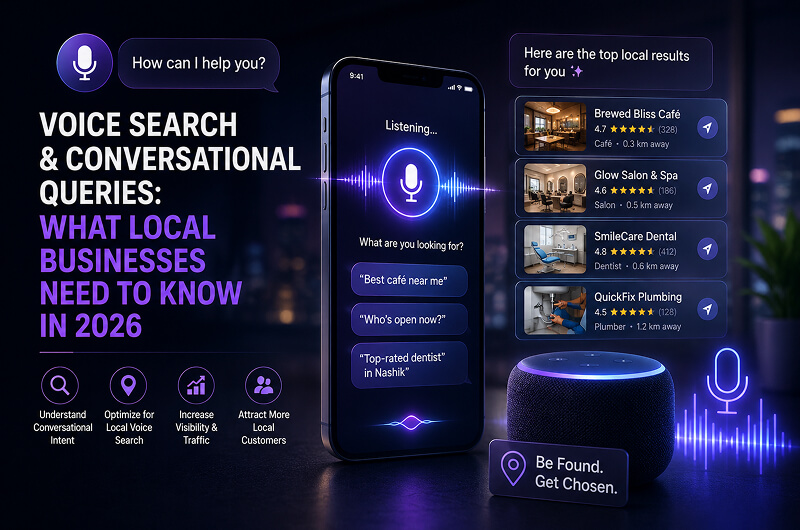
Voice queries now account for a significant share of local searches. Learn how to optimize your business content for the way people actually speak and win in voice-first search results.
The way people search for local businesses has changed dramatically. While typed queries remain dominant, voice search has become a mainstream behavior particularly for local, intent-driven lookups like “find a dentist open on Saturday near me” or “best pizza delivery in downtown Chicago.” In 2026, ignoring voice search is no longer a viable strategy for local businesses.
Voice search differs from typed search in several important ways. First, voice queries are longer and more conversational. While someone typing might enter “HVAC repair Dallas,” someone speaking would say “Who does emergency air conditioning repair in Dallas that’s available today?” This shift from keywords to questions means your content needs to answer complete questions, not just match isolated terms.
Second, voice search is overwhelmingly local. Studies consistently show that the majority of voice searches have local intent users are looking for nearby businesses, asking about hours, or requesting directions. This makes voice optimization inseparable from local SEO strategy.
To optimize for voice, start by auditing the questions your customers most commonly ask. Talk to your front desk staff, review your incoming calls and emails, and check the Q&A section of your Google Business Profile for patterns. These real-world questions are the foundation of your voice search content strategy.
Next, create dedicated FAQ pages on your website and within your directory listings that answer these questions in plain, conversational language. Avoid jargon. Write as if you’re speaking directly to a customer who just asked you a question face-to-face. Each answer should ideally be between two and five sentences long enough to be helpful, short enough to be read aloud naturally.
Schema markup also plays a critical role in voice search visibility. By tagging your business information with structured data including LocalBusiness schema, FAQPage schema, and HowTo schema where relevant you make it dramatically easier for voice assistants to extract and read out your content.
Mobile optimization and page speed are also essential. Voice searches happen almost exclusively on mobile devices, and search engines only pull results from pages that load quickly and render cleanly on smartphones.
Frequently Asked Questions
Q: What percentage of local searches are now voice-based?
A: Estimates vary by source and demographic, but industry data consistently places voice’s share of local searches between 20% and 30% in 2026, with growth projected as smart device adoption increases.
Q: Which voice assistants should I optimize for?
A: Focus primarily on Google Assistant (the dominant platform for business-related queries), followed by Amazon Alexa and Apple Siri. Google powers the vast majority of voice search results, making GBP optimization your highest-leverage activity.
Q: Does voice search optimization help with regular text search too?
A: Yes. FAQ content, structured data, and conversational writing that supports voice search also tends to perform well in featured snippets and AI-generated answers for typed queries. Voice optimization and AEO are closely intertwined strategies.