
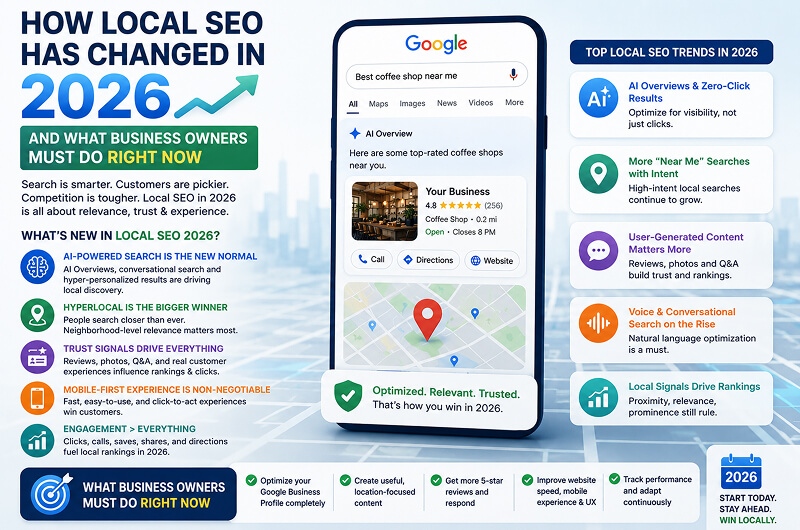
Local SEO in 2026 demands more than keywords proximity signals, review quality, and structured data now drive rankings. Learn what’s changed and how to stay ahead.
Local search engine optimization has never been more competitive or more rewarding than it is right now. In 2026, Google and other major search engines have fundamentally shifted how they evaluate local businesses, placing greater emphasis on behavioral signals, review authenticity, and hyperlocal content relevance. If you haven’t revisited your local SEO strategy in the last 12 months, there’s a good chance your competitors have already moved ahead.
One of the most significant changes is the growing importance of proximity-plus-intent matching. Search engines no longer just look at whether your business is geographically close to the searcher they also examine whether your content, services, and reviews closely match the specific intent behind the query. A restaurant that ranks well for “best tacos in Austin” might not appear for “family-friendly Mexican restaurants with parking in downtown Austin” unless its listing content is richly detailed and contextually relevant.
Reviews have also evolved from a simple star-rating game to a nuanced trust signal. Google now analyzes the language used in reviews, the recency of responses, and whether business owners engage thoughtfully with feedback. Businesses that consistently earn detailed, keyword-rich reviews and respond to them are rewarded with stronger local pack placement.
Another major trend is the increasing role of Google Business Profile (GBP) as a standalone discovery channel. Users are converting directly from GBP listings without ever visiting the business website. This means your profile needs to function as a mini-website complete with service descriptions, photo galleries, FAQs, and direct booking options where applicable.
Mobile-first indexing has also matured to a point where mobile page speed and Core Web Vitals are now baseline requirements, not bonus points. Any business whose website loads slowly on a phone is actively losing local traffic to faster competitors.
Finally, the rise of AI-assisted search has introduced a new layer of local SEO complexity. When AI systems summarize local results, they pull from structured data, verified listings, and high-authority content. Businesses that invest in clean, consistent NAP (Name, Address, Phone) data across all directories including platforms like City Verified gain a meaningful edge in AI-curated results.
Frequently Asked Questions
Q: How often should I update my Google Business Profile?
A: Aim to update your GBP at least once a week with new photos, posts, or offer updates. Consistent activity signals to Google that your business is active and engaged, which positively influences local ranking.
Q: Does listing my business on multiple directories still help with local SEO?
A: Absolutely. Consistent NAP citations across trusted directories reinforce your business’s credibility with search engines. Focus on quality platforms with strong domain authority and verified listing processes.
Q: How important are responses to negative reviews for SEO?
A: Very important. A professional, empathetic response to a negative review demonstrates accountability and customer care. Search engines interpret this engagement as a sign of an active, reputable business which can positively impact your local ranking.