
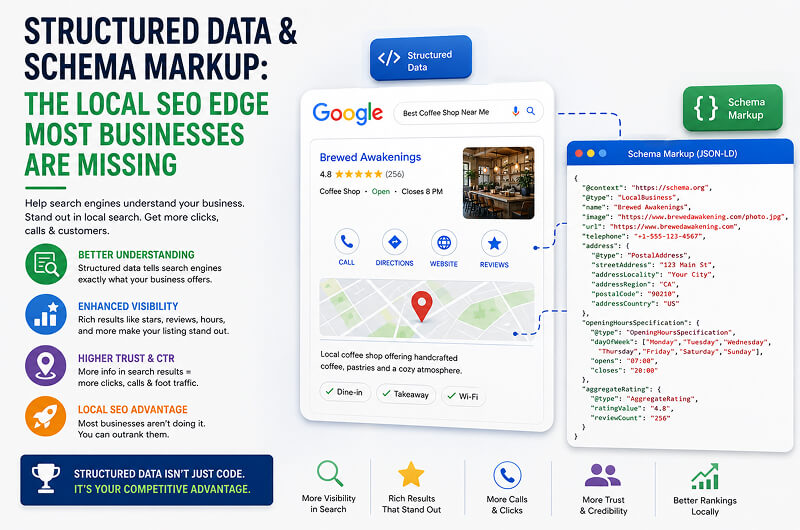
Schema markup turns your website into a machine-readable source for search engines and AI. Most local businesses still skip it making it one of the highest-ROI SEO opportunities available.
In the world of local SEO, there’s a gap between businesses that get consistently discovered online and those that struggle for visibility despite doing everything else right. That gap often comes down to one technical but highly accessible strategy: structured data and schema markup.
Schema markup is a standardized language developed by Google, Bing, Yahoo, and Yandex collectively that allows you to explicitly label the content on your website. Rather than leaving search engines to guess what your page is about, you tell them directly: “This is a local business.” “These are our business hours.” “This is a customer review.” “This is a FAQ with answers.” That clarity translates into dramatically better search results, richer snippets, and higher placement in AI-generated answers.
For local businesses, the most valuable schema types are LocalBusiness (and its many subtypes, such as Restaurant, AutoRepair, MedicalBusiness, etc.), FAQPage, Review, and OpeningHoursSpecification. Together, these schemas give search engines a comprehensive, machine-readable profile of your business that they can confidently use to answer user queries.
Implementing schema doesn’t require advanced technical skills. Google’s Structured Data Markup Helper is a free, user-friendly tool that walks you through the process of tagging your existing content. Many WordPress plugins including Yoast SEO and RankMath offer built-in schema generation with minimal configuration required.
The payoff from schema implementation is measurable and often significant. Businesses that implement LocalBusiness schema frequently see improvements in their local pack rankings within weeks. FAQPage schema often results in expanded search snippets that take up more real estate on the results page reducing competitor visibility while increasing your own.
For AI-era search in particular, schema is indispensable. AI systems are designed to process structured data more efficiently than unstructured text. A business listing supplemented by rich schema markup on its website gives AI assistants everything they need to confidently recommend that business in response to relevant queries.
The most important thing is to start. Even implementing basic LocalBusiness schema covering your name, address, phone number, hours, and primary service category delivers meaningful SEO benefits that compound as search engines index and trust your structured data over time.
Frequently Asked Questions
Q: Does schema markup directly improve my Google ranking?
A: Schema markup is not a direct ranking factor in the traditional sense, but it significantly improves how search engines understand and represent your content which leads to better placement in rich results, featured snippets, and AI answers, all of which drive more traffic.
Q: Can I implement schema markup without touching any code?
A: Yes. Google’s free Structured Data Markup Helper lets you tag content visually, and many SEO plugins for WordPress and other CMS platforms generate schema automatically based on your settings. For most local businesses, a plugin-based approach is sufficient.
Q: How do I know if my schema markup is working correctly?
A: Use Google’s Rich Results Test tool (available at search.google.com/test/rich-results) to validate your schema. It will show you exactly what Google can read from your page and flag any errors that need correction.